Mutual Fund Commentary

Intrepid Income Fund

4Q 2025

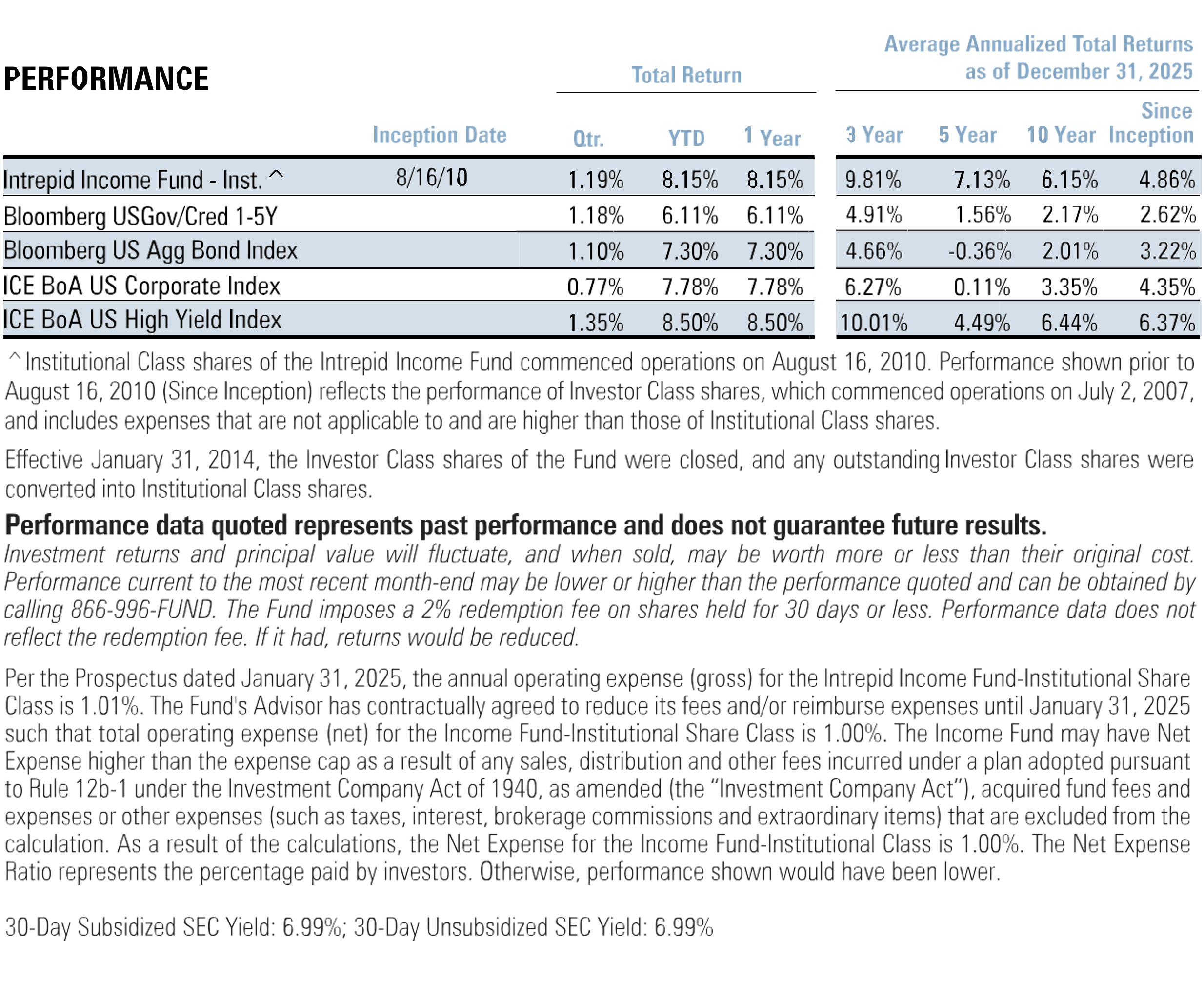
Income Fund - Performance 4Q 2025

January 4, 2026

Dear Fellow Shareholders,

The fourth quarter of 2025 proved to be a fitting conclusion to what was a strong year for credit markets. Despite intermittent bouts of volatility, risk assets finished the year on solid footing. Major equity indices continued to grind higher and closed the year near all-time highs. Credit markets also fared well. Rates ended the year relatively flat, leading to modest positive returns for investment grade bonds in the fourth quarter. High yield credit performed slightly better, with the broadly followed indices delivering returns of approximately 130-140 basis points.

High yield credit spreads saw some moderate widening at various points in the quarter, as investors reacted to risks of further trade flare ups and a less dovish Fed. High yield spreads ended the quarter about 20 basis points wide of the multi-year lows from earlier in the year, but remain tight by historical standards at around 300 basis points at year-end.
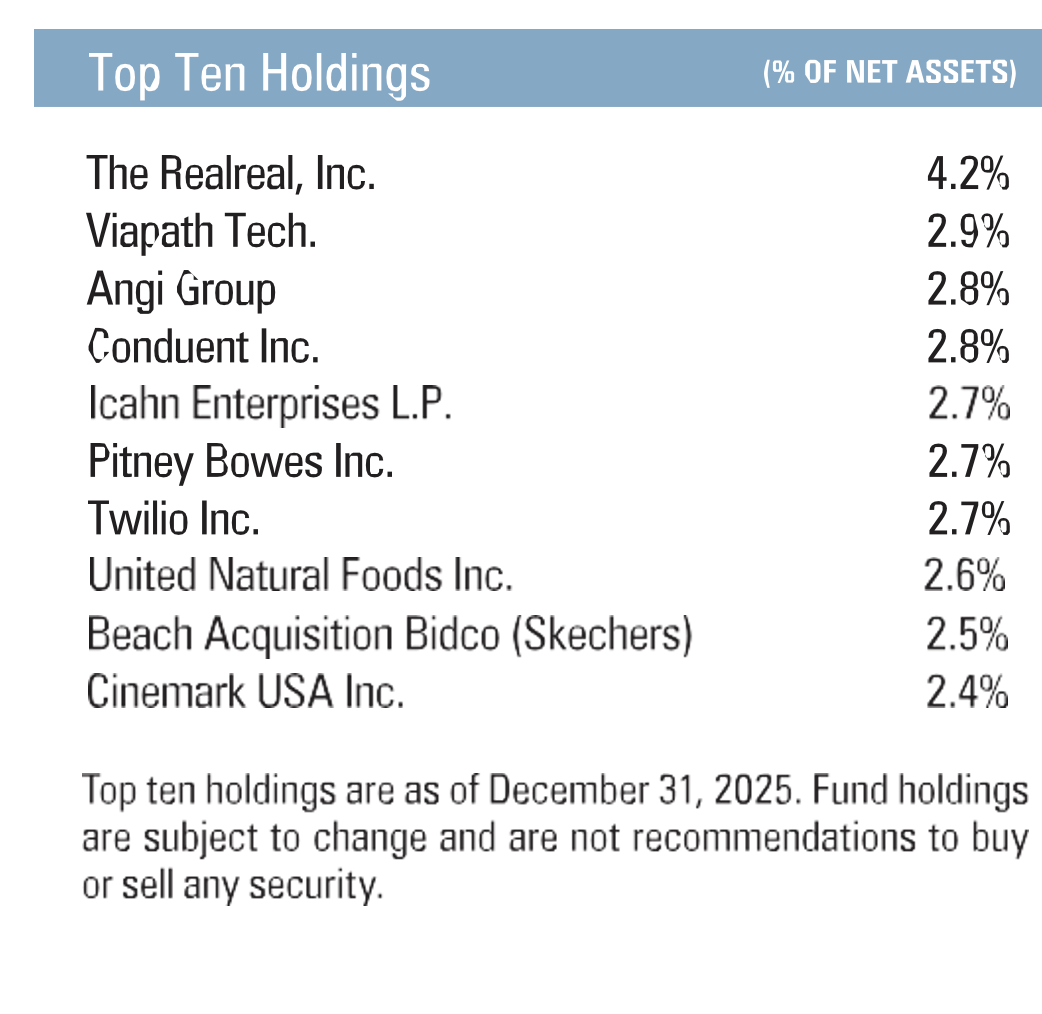
Income Fund - Top 10 Holdings 4Q 2025

The Intrepid Income Fund (the “Fund”) delivered a return of 1.19% for the quarter ended December 31, 2025, compared to a return of 1.18% for its benchmark Bloomberg US Gov/Credit 1-5 Year Index. For the full year, the Fund returned 8.15% compared to 6.11% for its benchmark. We are particularly pleased with the Fund’s recent performance relative to high yield indices. For the three years ended December 31, 2025, the Fund’s 9.8% annualized return was just a notch below the 10.0% of the widely followed ICE BofA High Yield Index. While downside  protection is our goal, participating in bull markets is another important feature. Our recent upside capture has exceeded our expectations, which we attribute mainly to good idiosyncratic performance in certain credits rather than a more risk-on tactical positioning. We continue to fund value in smaller issue, off-the-run credits that we believe offer comparable return to High Yield indices, but with less risk.

The portfolio continues to be anchored by credits with strong balance sheets, identifiable asset coverage, and durable free cash flow. Among the more notable contributors to performance during the quarter were a handful of positions in the consumer and communications sectors that benefited from strong operating results and spread compression specific to those issuers. The top contributors meaningfully outpaced the drag from our top detractors.

We ended the quarter with a yield-to-worst of approximately 8.0%, which is relatively consistent with prior quarters and reflects a similar spread with some movement in rates. The Fund’s effective duration was 1.8 years atquarter-end, which is about 0.3 years below prior quarter and the first quarter below 2 years since 2023. This shortening was mainly due to a larger number of credits trading at levels that would imply being called early, thus reducing their effective duration. Other duration metrics, such as average maturity, remain relatively unchanged from the prior quarter. We continue to hold a mix of core positions with maturities ranging from 2-5 years as well as positions with an imminent maturity or call date.

Entering 2026, we find ourselves in a familiar position: cautiously optimistic about the opportunity set, but mindful that valuations in credit are not cheap by historical standards. As we have noted in prior commentaries, we believe the credit quality of the high yield index is healthier than in prior cycles. Ratings mix skews higher, the portion of secured debt is higher, and many companies have exploited the favorable credit environment of the last several years to extend maturities. Furthermore, we think the rapid growth in private credit picked off a number of would-be public credits at the riskier end of the spectrum.

On the other hand, spreads remain tight relative to long-run averages, and a number of macroeconomic crosscurrents — including residual tariff impacts, a gradually softening labor market, and an uncertain path for monetary policy — warrant continued vigilance. We recognize that the credit conditions of the last three years have been mostly benign by historical standards and are prepared for more volatility in 2026.

For now, we remain focused on what we can control: identifying creditworthy issuers in our core niche of small issue, less-followed fixed income securities, and maintaining the shorter duration profile that has served the Fund well across a variety of environments. We believe the portfolio is well-positioned to deliver attractive absolute returns withless rate sensitivity, while providing meaningful downside protection should credit conditions deteriorate.

As always, we welcome outreach and would welcome the opportunity to discuss the portfolio with you in more detail. Thank you for your trust and investment.

Sincerely,



Hunter Hayes, CFA, Chief Investment Officer
Intrepid Income Fund Co-Portfolio Manager



Mark F. Travis, President
Intrepid Income Fund Co-Portfolio Manager



Matt Parker, CFA, CPA
Intrepid Endurance Fund Co-Portfolio Manager


Joe Van Cavage, CFA
Intrepid Endurance Fund Co-Portfolio Manager

Past performance is not a guarantee of future results.
Mutual Fund investing involves risk. Principal loss is possible. Investments in debt securities typically decrease in value when interest rates rise. The risk is generally greater for longer term debt securities. Investments by the Fund in lower-rated and non-rated securities present a greater risk of loss to principal and interest than higher rated securities. The Fund may invest in foreign securities which involve greater volatility and political, economic and currency risks and differences in accounting methods.
This material must be preceded or accompanied by a prospectus. The Funds’ investment objectives, risks, charges and expenses must be considered carefully before investing. The prospectus contains this and other important information about the investment company. Please read it carefully before investing. A hard copy of the prospectus can be requested by calling 866-996-FUND (3863).
The ICE BoA US High Yield Index tracks the performance of US dollar denominated below investment grade corporate debt publicly issued in the US domestic market. Qualifying securities must have a below investment grade rating (based on an average of Moody’s, S&P and Fitch), at least 18 months to final maturity at the time of issuance, at least one year remaining term to final maturity as of the rebalancing date, a fixed coupon schedule and a minimum amount outstanding of $250 million. Bloomberg U.S. Aggregate Bond Index is an index representing about 8,200 fixed income securities. To be included in the index, bonds must be rated investment grade by Moody’s and S&P. ICE BoA US Corporate Index is an unmanaged index of U.S. dollar denominated investment grade corporate debt securities publicly issued in the U.S. domestic market with at least one-year remaining term to final maturity. The Bloomberg US Gov/Credit 1-5Y TR Index measures the performance of U.S. dollar-denominated U.S. Treasury bonds, government-related bonds, and investment-grade U.S. corporate bonds that have a remaining maturity of greater than or equal to one year and less than five years. The ICE BoA CCC & Lower Index tracks the performance of US dollar denominated below investment grade corporate debt publicly issued in the US domestic market. Qualifying securities must have a rating of CCC or lower (based on an average of Moody’s, S&P and Fitch).
The 30-day SEC yield calculation is an annualized measure of the respective fund’s dividend and interest payments for the last 30 days, less the respective fund expenses. The 30-day subsidized SEC yield reflects fee waivers and/or expense reimbursements during the period. The 30-Day unsubsidized SEC yield reflects what a fund’s 30-Day SEC yield would have been had no fee waivers or expense reimbursement been in place over the period.
Bond ratings are grades given to fixed income securities that indicate their credit quality as determined by private independent rating services such as Standard & Poor’s, Moody’s and Fitch. These firms evaluate a bond issuer’s financial strength, or its ability to pay a bond’s principal and interest in a timely fashion. Ratings are expressed as letters ranging from ‘AAA’, which is the highest grade, to ‘D’, which is the lowest grade. In limited situations when the rating agency has not issued a formal rating, the rating agency will classify the security as nonrated. Intrepid utilizes Standard & Poor’s credit ratings when tabulating the ratings for individual fixed income securities.
A high-yield bond is a high paying bond with lower credit rating than investment-grade corporate bonds, Treasury bonds and municipal bonds. Bonds in high yield indices tend to be less liquid and more volatile than U.S. Treasuries. Corporate bonds come with significant credit risks and, although sometimes secured by collateral, do not have any guarantee of principal repayment. U.S. Treasury Bonds are long-term government debt securities with a maturity of more than 10 years. They are guaranteed as to the timely payment of principal and interest and are backed by the full faith and credit of the U.S. Government. Investment Grade (IG) is a bond with credit rating of BBB or higher by Standard & Poor’s or Baa3 or higher by Moody’s.
Duration is an approximate measure of the price sensitivity of a fixed-income investment to a change in interest rates, expressed as a number of years. Call is an option contract that gives the holder the right to buy a certain quantity of an underlying security from the writer of the option, at a specified price up to a specified date.
Yield-to-worst (YTM) is a measure of the lowest possible yield that can be received on a bond that fully operates within the terms of its contract without defaulting. It is a type of yield that is referenced when a bond has provisions that would allow the issuer to close it out before it matures.
Yield-to-call (YTC) is the return a bondholder will be paid if the bond is held until the call date, which will occur sometime before the bond reaches maturity.
Free cash flow, or cash flow, represents the cash a company generates after accounting for cash outflows to support operations and maintain its capital assets.
Basis point is a standard financial measure for interest rates. One basis point equals 1/100th of 1%.
Current yield is the annual income (interest or dividends) divided by the current price of the security.
Opinions expressed are subject to change, are not guaranteed and should not be considered investment advice or recommendations to buy or sell any security.
The Intrepid Capital Funds are distributed by Quasar Distributors, LLC.
View More